

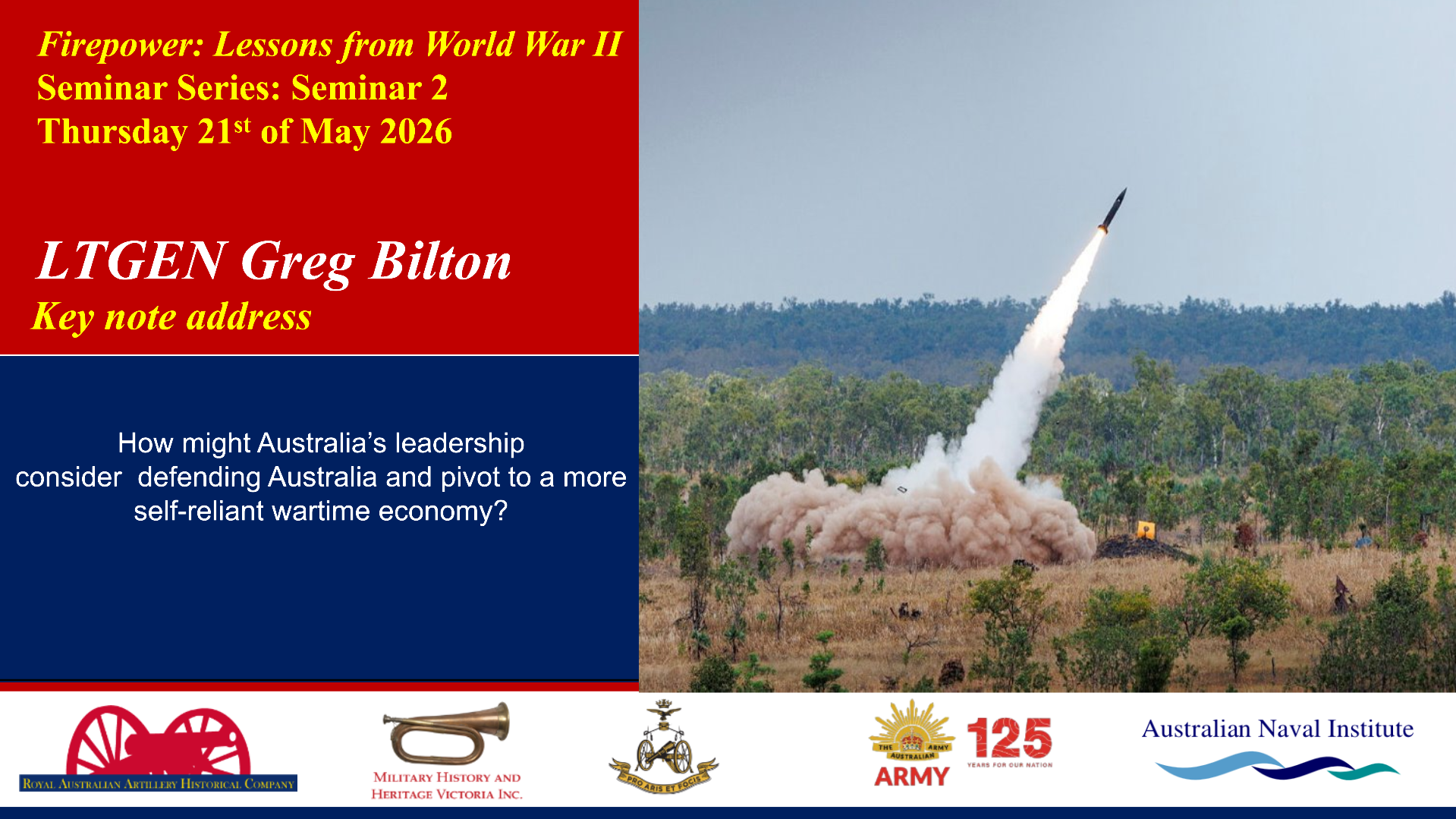
Presenter: General Greg Bilton, former Chief of Joint Operations (CJOPS)
Event: Firepower: Lessons from World War II seminar series — Royal Australian Artillery Historical Company
Seminar Overview
General Greg Bilton, former Chief of Joint Operations of the Australian Defence Force, argues that Australia is underprepared for state-on-state conflict and that the window for action is narrowing. Presented as part of the Royal Australian Artillery Historical Company’s Firepower: Lessons from World War II seminar series, and drawing on his 2019–2024 tenure overseeing Australia’s campaign plan and contingency plans, Bilton frames his argument around three challenges: civil defence, sovereign capability, and allies and partners. He situates the discussion against the return of state-on-state conflict in Ukraine, Israel, and the Indo-Pacific, the cyber and cognitive domains contested by the Australian Signals Directorate, and the lessons of Operations Oboe and Cartwheel from the Second World War.
On civil defence, Bilton’s claim is blunt: the last time Australia seriously planned the transition from peace to war was the War Book of 1956, while Sweden and its Scandinavian neighbours maintain living civil defence models. On sovereign capability, he identifies long-range strike — not invasion — as Australia’s primary threat, illustrated by a Chinese H-6 bomber over Borneo able to fire nine missiles that reach Darwin in 21 minutes, creating a counter-at-the-source dilemma. The pace of rival militarisation is stark: Russia producing 1,500 tanks per year against NATO’s 500, and China building eight nuclear submarines between 2023 and 2026. Against this, the Integrated Investment Program delivers most capability after 2035 and, Bilton argues, advantages prime contractors over Australian industry — while the force in being is what you fight with. He points to the Hughes government’s 1921 Munitions Supply Board as the precedent for serious sovereign industrial planning.
On allies and partners, Bilton positions Japan as the key regional counterweight and traces how the Philippines’ strategic outlook changed after Marawi in 2017, framing alliance weight within integrated statecraft — the DIME spectrum, the Office of the Pacific, and AUSMIN. The presentation closes on how autonomous systems can generate mass and create multiple concurrent dilemmas for an adversary.
Panel Discussion
The question and answer session surfaces the uncomfortable specifics of preparedness. Discussion points include Australia’s mobilisation gaps and what the wartime mobilisation of over a million people implies for today’s standby reserve, a defence estate not sized for expansion, and the value of shadow posting into Joint Operations Command developed through the Taipan series of command post exercises and JOC contingency planning. The session also examines the tyranny of distance alongside Scandinavian civil defence models, and identifies inter-service cultural hubris and interdependencies as the ADF’s primary operational bottleneck, reinforcing the integrator role at the joint level.