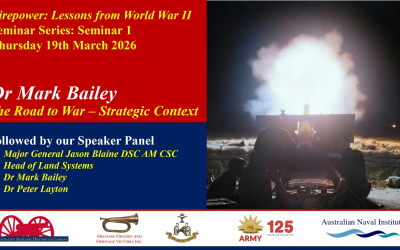



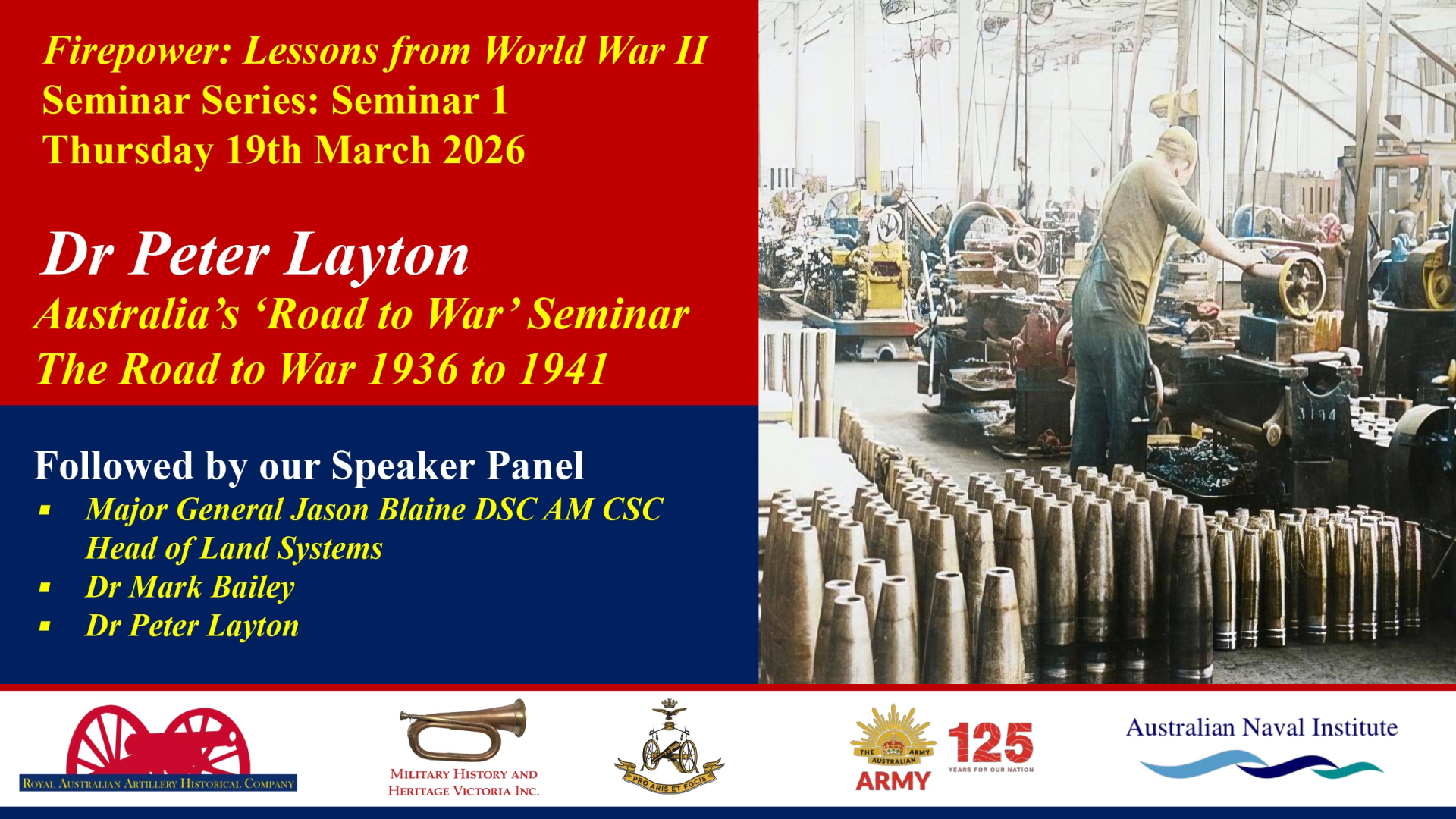
Dr Peter Layton on how the Munitions Supply Board, shadow factories, and the self-containment strategy built the industrial base that sustained Australia through total war and why those lessons matter now.
Presenter: Dr Peter Layton
Panel: Major General Jason Blain, DSC, AM, CSC; Dr Mark Bailey; Dr Peter Layton
Event: The Road to War: Preparedness and Mobilisation (1936–1941), Melbourne — 19 March 2026
Seminar Overview
Between the wars, Australia quietly assembled a defence industrial framework that proved equal to the demands of global conflict, a strategic achievement the country has since allowed to fade from institutional memory. In this Firepower Seminar presentation, Dr. Peter Layton reconstructs the planning architecture behind that success, from the establishment of the Munitions Supply Board in 1921 through the adoption of a self-containment strategy and the creation of a shadow factory network modelled on the British system, which enabled wartime production to scale rapidly without cannibalising civilian industry.
Dr Layton grounds his analysis in the hard lesson the First World War had delivered. Australia entered that conflict as an economy almost entirely reliant on primary exports, with virtually no domestic arms manufacturing. A small cadre of strategic thinkers recognised that future conflict would require the nation to produce its own weapons and ammunition independently of overseas supply. The Munitions Supply Board was created to make that possible, operating under Prime Minister Stanley Bruce’s insistence on uniformity of armaments with Britain, a policy that ensured anything manufactured in Australia could be used interchangeably alongside British-produced equipment.
The results, measured against the modest starting point, were remarkable. A peacetime army of approximately 3,000 regulars grew into a wartime force of 730,000 — 400,000 of whom served in theatres abroad sustained by 243 shadow factories and a production apparatus that delivered 1.8 billion rounds of small arms ammunition before the war’s end. Much of this expansion was propelled by Essington Lewis, who took charge as Director General of Munitions in 1940 and wielded considerable personal authority to accelerate output, at times overriding service departments that had stalled procurement even as France fell and the strategic situation deteriorated.
“The foundations of munitions production in Australia were well laid in the interwar period for the needs of the time. Today the needs are infinitely greater.”
— Essington Lewis, Director General of Munitions, 1940
Panel Discussion: Modern Parallels and Current Capability
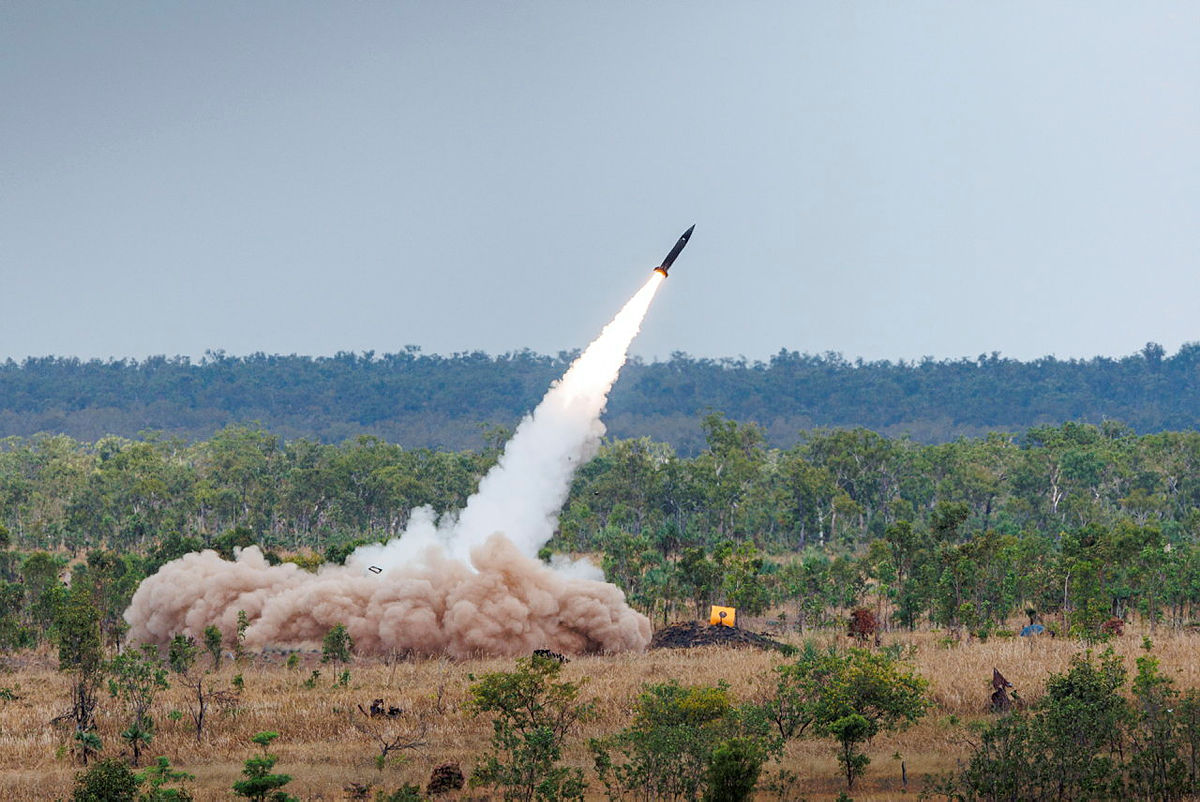
The panel discussion that follows Dr Layton’s presentation brings the historical analysis into direct conversation with today’s defence challenges. Major General Jason Blain discusses the current state of Australian Army modernisation, focusing on the introduction of Long Range Fires through HIMARS and the Precision Strike Missile program. The panel explores the uncomfortable parallels between the interwar period and the present day: the five-to-six-year lead times required to establish missile production lines, the tension between global supply chains and sovereign manufacturing capability, and the question of whether Australia’s current approach to defence industry carries the strategic coherence that characterised the interwar program. The discussion also addresses the practical realities of modern ammunition supply — what magazine depth means when precision munitions cost orders of magnitude more than the 25-pounder rounds of WWII, and what the training pipeline looks like when transitioning from legacy systems to platforms that fundamentally change how artillery operates.
Prefer Audio? This seminar is also available on the Principles of War Podcast