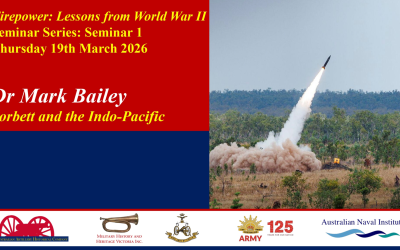



Dr Mark Bailey on how a bipartisan 20-year industrial strategy transformed Australia from agricultural exporter to war-ready industrial power and what it means for today’s defence posture.
Presenter: Dr Mark Bailey
Panel: Major General Jason Blain, DSC, AM, CSC; Dr Mark Bailey; Dr Peter Layton
Event: The Road to War: Preparedness and Mobilisation (1936–1941), Melbourne — 19 March 2026
Seminar Overview
What does it take for a nation built on agriculture and raw exports to forge an industrial base capable of waging total war within two decades? In the opening address of the RAAHC’s Firepower Seminar Series, former Royal Australian Navy officer, Dr Mark Bailey and fellow at the ADFA Naval Studies Group, makes a compelling case that the national industrialisation effort Australia pursued between 1919 and 1939 stands as the most effective act of strategic governance the country has ever undertaken. Remarkably, it remains largely unknown to the Australian public.
Dr Bailey unpacks the strategic calculus behind this transformation. The First World War had laid bare a critical vulnerability: Australia occupied a position at the confluence of three oceans, its economy ran on maritime trade, and Japan was emerging as the one serious threat in the region. In response, successive governments working across party lines and largely out of public view embarked on a deliberate program to establish domestic manufacturing capacity for munitions, military equipment, and war materiel. The objective was straightforward: if supply lines from Britain were severed, Australia had to be able to sustain its own defence.
The outcome exceeded what most planners could have anticipated. When Japanese military staff drew up plans in 1942 to put two area armies ashore at Port Stephens, the force they would have encountered was, in Dr Bailey’s assessment, sufficient not just to repel the landing but to destroy the invading armies outright. From a population of only 7 million, Australia placed 730,000 men and women in uniform — 400,000 of whom deployed overseas while its factories turned out 1.8 billion rounds of small arms ammunition over the course of the war.
“The entire point of building up secondary industry in Australia from 1919 onwards, as a lesson of World War I, was aimed specifically and strategically against the Empire of Japan, full stop.”
— Dr Mark Bailey
Panel Discussion: Connecting History to Army Transformation
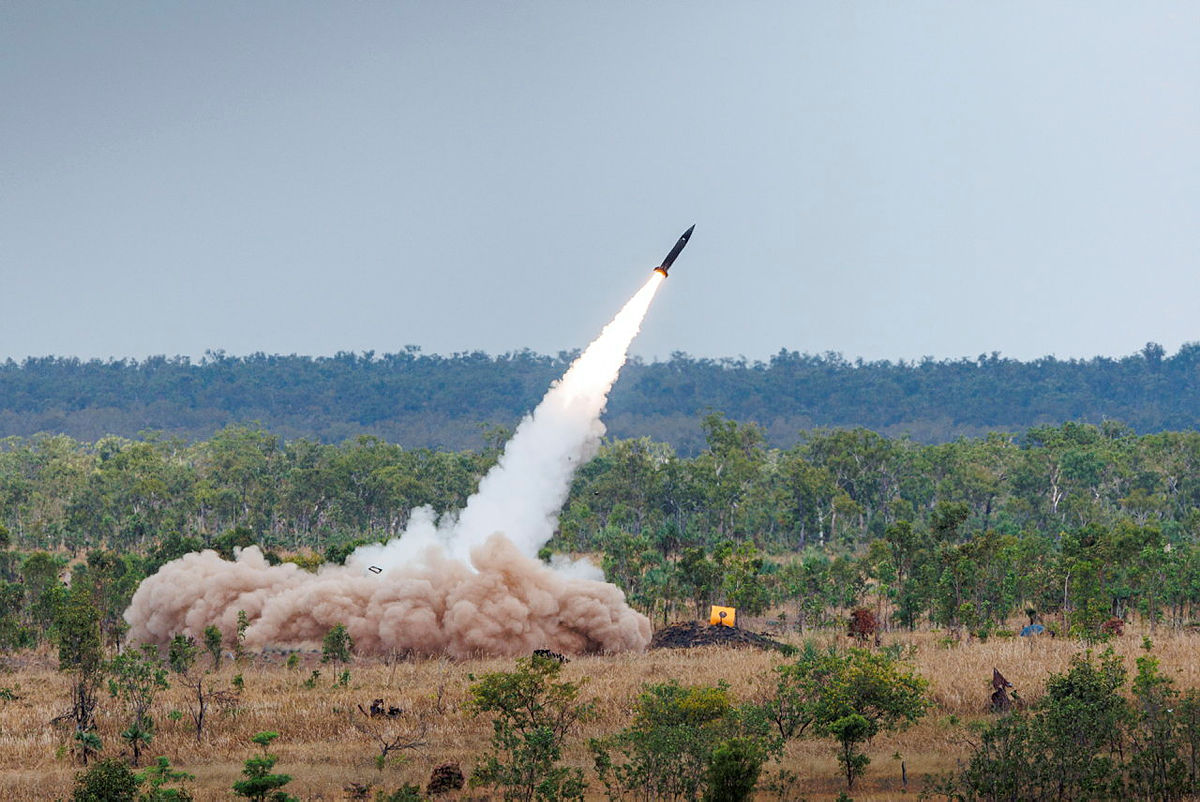
Following Dr Bailey’s presentation, Major General Jason Blain head of Land Systems Division in the Capability Acquisition and Sustainment Group (CASG) joins the panel to connect these historical lessons to the Australian Army’s current transformation. The discussion examines the most profound capability change in the Royal Australian Artillery’s history: the introduction of Long Range Fires through the High Mobility Artillery Rocket System (HIMARS), the Precision Strike Missile (PrSM), and the AS9 Huntsman self-propelled howitzer. Major General Blain explores what these systems mean for a fundamental doctrinal shift from the traditional model where fires support manoeuvre, to a future where manoeuvre supports fires. The panel then addresses whether Australia’s current defence industrial approach carries the same strategic coherence that characterised the interwar program, or whether the nation has lost institutional memory of what made that earlier effort succeed.
Prefer Audio? This seminar is also available on the Principles of War Podcast